


Most property owners do not think about their commercial roof until water is coming through the ceiling of their storefront, warehouse, or apartment building. By that point, the problem has usually been developing for months — quietly rotting decking, slowly corroding flashing, steadily saturating insulation that now costs three to four times more to address than it would have just a few weeks earlier.
Commercial roofing in New York operates under an entirely different set of rules, pressures, and failure patterns than residential roofing. The contractors who genuinely understand those differences are not the same crew who installs asphalt shingles on a ranch house in Hempstead. Knowing what separates the two — and what questions to ask before signing any contract — is how property owners in Nassau County and Queens protect what is often one of their most significant assets.
Here is what gets property owners into trouble, and what working with qualified commercial roofing contractors in New York actually looks like.
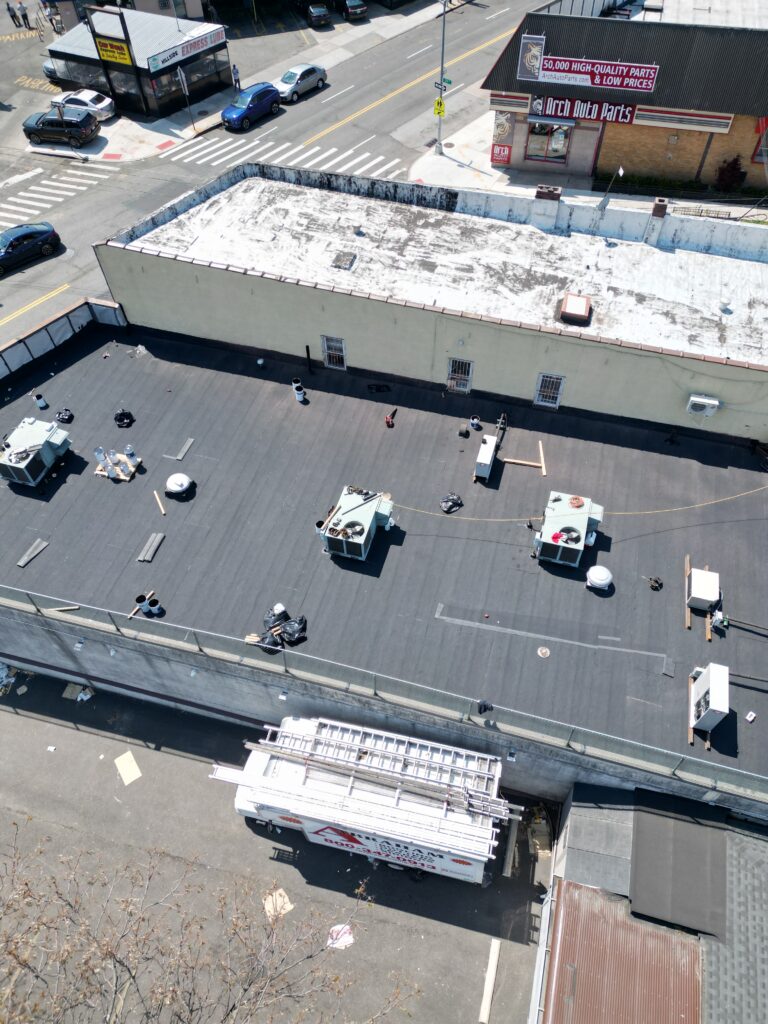
A Commercial Roof Is Not Just a Bigger Residential Roof
This is the most common and most expensive misconception in commercial property ownership. A flat roof on a storefront or apartment building is not a stretched-out version of what sits on a house. The systems, the failure modes, the code requirements, and the maintenance schedules are entirely different.
Commercial flat roofs are typically built around membrane systems — TPO (Thermoplastic Polyolefin), EPDM (Ethylene Propylene Diene Monomer), or modified bitumen. Each system has distinct drainage requirements, different seam vulnerabilities, and different responses to New York’s climate extremes. TPO and EPDM membranes that look visually intact from the rooftop can be actively failing at the seams or penetrations long before any interior damage becomes visible.
New York’s building code addresses commercial roof assemblies specifically under Chapter 15, setting distinct standards for drainage, fire classification, structural load, and insulation. Since December 31, 2025, all new permit applications must comply with the updated 2025 Uniform Code, which tightened energy insulation requirements and introduced continuous insulation standards designed to reduce thermal bridging. A commercial roofing contractor in New York who is unfamiliar with these requirements is already operating behind the current standard.
If you are unsure what roofing system your commercial property currently has or whether it was installed to current code, that is exactly the kind of question a professional inspection should answer.
The Ponding Problem Nobody Talks About Enough
Flat roofs are engineered to drain. They are not engineered to hold water. But in New York — where spring rainfall can be sustained and summer storms can drop several inches in a matter of hours — standing water, also called ponding, is one of the most consistently destructive forces a commercial roof faces.
Water that sits on a flat roof membrane for more than 48 hours begins accelerating deterioration in ways that compound over time. It weakens seam bonds, softens the membrane, and adds structural load the building was not designed to carry continuously. Meanwhile, the humidity underneath works on the insulation layer and the decking simultaneously. The membrane may still look acceptable from the surface while the system beneath it is actively degrading.
A qualified commercial roofing contractor in New York evaluates drainage patterns before recommending any repair or replacement scope. Installing new membrane over an existing drainage problem is not a solution — it is a delay. The ponding returns, and the new membrane fails faster than the old one did because the underlying conditions were never corrected.
Before any commercial roofing project, ask specifically whether the drainage assessment is part of the scope. If the contractor does not raise it independently, that tells you something important about their process.
Why Commercial Roof Inspections Work Differently
Residential roofs can often be meaningfully assessed from the ground or a standard ladder. Commercial flat roofs — particularly those on buildings two stories or higher — require a trained inspector working at close range with the right diagnostic tools.
The most significant advancement in commercial roof inspection over the past several years is the widespread adoption of infrared thermography and moisture scanning. These tools detect temperature differentials across the roof surface. Because wet insulation absorbs and releases heat at a different rate than dry material, moisture trapped beneath an intact-looking membrane appears as a distinct thermal signature. A trained eye reading an infrared scan can identify failing sections, compromised seams, and moisture accumulation that would be completely invisible in a standard visual inspection.
A water infiltration that shows up as a ceiling stain in March may have started as a failed seam or a compromised penetration seal the previous autumn. Six months of moisture cycling through insulation and decking before the interior stain appears — that is the gap between what a visual inspection finds and what thermal imaging finds.
Annual commercial roof inspections are not an upsell. They are the mechanism that converts a $2,000 localized repair into something that does not become a $20,000 replacement.
The Multi-Family Property Challenge in Queens and Nassau County
Two-family homes, apartment buildings, and mixed-use commercial-residential properties represent a substantial portion of New York’s building stock — particularly in Queens, where flat roofs are the dominant format across both residential and commercial properties.
These buildings carry a specific legal and financial burden that single-family homeowners do not face. As the building owner, you are responsible for the condition of the roof over your tenants. A leak that damages personal property, displaces a tenant, or renders a unit temporarily uninhabitable creates liability that extends well beyond the cost of the repair itself. In New York, tenant rights around habitability are among the strongest in the country, and a documented history of deferred roof maintenance is not a position any landlord wants to be in during a dispute.
For property owners managing multi-family buildings in Queens or Nassau County, proactive commercial roofing services in New York are not optional — they are part of the basic obligation of responsible ownership. The contractors who specialize in this work understand the timeline is not determined by convenience. It is determined by the weather forecast.
To understand what proactive roof maintenance looks like over the life of a building, read our guide here: The Advantages of Professional Roofing Maintenance.
What to Look for When Hiring Commercial Roofing Contractors in New York
The standards for evaluating a commercial roofing contractor are more rigorous than for residential work, and for good reason. The buildings are more complex, the systems are more specialized, and the consequences of a poor installation are proportionally more expensive.
Insurance at the commercial level. Commercial roofing projects require significantly higher liability limits than residential jobs. A general liability policy that is adequate for a house installation is not adequate for a commercial building. Before any contract is signed, request a certificate of insurance with commercial-level coverage limits and verify it directly with the carrier.
Manufacturer certifications specific to commercial systems. GAF, Carlisle, and other major manufacturers maintain separate certification tracks for commercial membrane installation. A contractor certified to install residential asphalt shingles is not automatically qualified to install TPO or EPDM commercial membrane systems. Ask specifically which commercial certifications they hold and what warranty coverage those certifications unlock.
Warranty structure clarity. Commercial roof warranties can be layered and complex. They may cover materials only, or materials and labor together, or they may include a No Dollar Limit (NDL) warranty that covers the full cost of repair or replacement regardless of the scope required. Understand exactly what your warranty covers — and what can void it — before work begins.
A written scope that includes drainage. Any commercial roofing contractor who presents an estimate without addressing drainage has given you an incomplete assessment. This is not a minor detail. Drainage is fundamental to how a flat roof system performs and how long it lasts.
To understand more about what separates qualified commercial roofing contractors from those who handle residential work only, read our hiring guide here.
The Real Cost of Waiting
Here is the number that should make this concrete: commercial roof replacement in the New York area currently runs between $8 and $20 per square foot, depending on the system type, building complexity, and current material costs. A modest 3,000 square foot commercial roof on a small apartment building or retail property can cost $60,000 or more to replace in full.
That same roof, addressed at the point of a localized membrane failure with no underlying insulation damage, might cost $2,500 to $4,000 to repair correctly.
The financial logic is straightforward. What changes the outcome is not the math — it is whether a property owner decides to pay attention before or after the ceiling gives way. Annual inspections, proactive repairs, and a relationship with a contractor who knows your building are what keep the $4,000 repair from becoming the $60,000 replacement.
If your commercial property has not had a professional roof inspection in the past twelve months, that is where this conversation should start.
Conclusion
Commercial roofing problems rarely begin with dramatic leaks or visible damage. Most failures start quietly — trapped moisture, poor drainage, aging seams, or deferred maintenance that gradually weakens the entire roofing system. For property owners in New York, especially those managing apartment buildings, mixed-use properties, or commercial facilities, staying proactive is the difference between a manageable repair and a major financial burden.
Regular inspections, proper drainage evaluations, and working with experienced commercial roofing contractors can significantly extend the life of your roof while helping you avoid costly structural damage and tenant-related issues. Understanding how commercial roofing systems function — and addressing problems early — protects both your property investment and your long-term operating costs.
At Abraham Roofing, we understand the unique challenges commercial properties face throughout New York. Our team provides reliable commercial roofing inspections, repairs, maintenance, and replacement services designed to keep your building protected year-round. Whether you own a retail property, warehouse, apartment building, or mixed-use facility, Abraham Roofing is committed to delivering durable roofing solutions backed by professional expertise and quality workmanship
